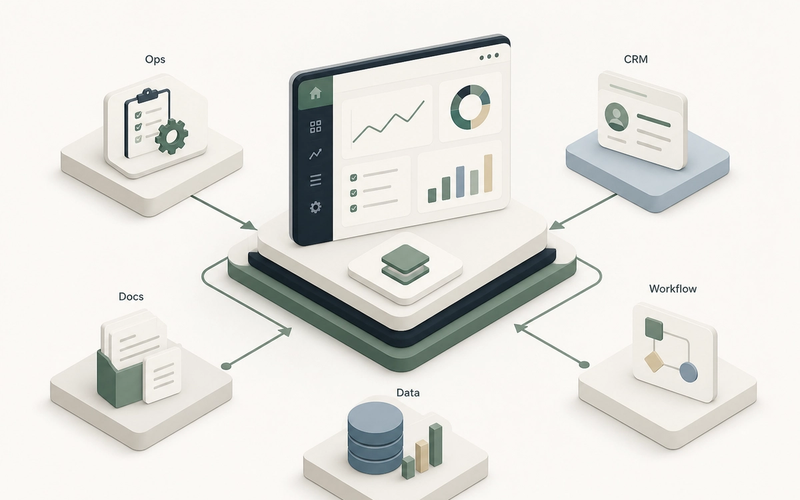
Custom internal business software becomes relevant when the business has outgrown SaaS templates: processes are too specific, teams are constrained by software compromises, data is scattered, and workflows need to be unified in an internal application or platform whose outline is already visible, even if it still needs to be built properly.
The essentials
- Custom software is not the default answer. It becomes rational when the need is strategic, specific, broadly stable and not properly covered by a configured SaaS product.
- The wrong question is: “which features do we want?”. The better question is: “which business system do we need to make reliable, measurable, maintainable and transferable?”
- A good internal MVP should cover a narrow scope, but it cannot ignore security, access rights, data quality, backups and operations.
The real cost of not having the right tool yet
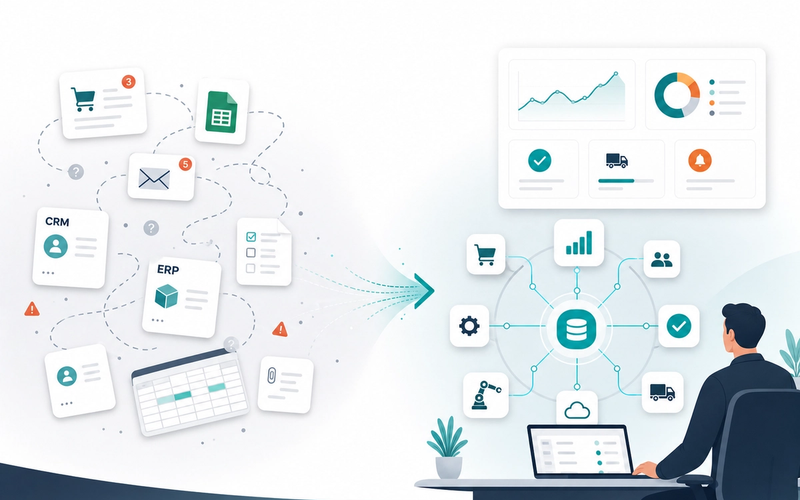
The problem almost never starts as a major strategic topic. It starts with small adjustments: a shared spreadsheet, a business rule kept in someone’s head, a manual export, a misused CRM field, an approval sent by message, then a control added at the end of the process.
Each workaround may look reasonable on its own. Together, they create an invisible system: nobody designed it, but everyone depends on it. The cost is not only wasted time. It appears in errors that are hard to trace, decisions made from inconsistent data, dependency on key people, painful audits, long onboarding cycles and the inability to improve the process without breaking something.
This is where custom internal business software becomes a serious question. Not because the company needs more “digital transformation”, but because it already has an implicit internal product. The only question is whether it should remain scattered across spreadsheets, SaaS tools and oral habits, or become a reliable system.
Custom internal business software: four signals that justify scoping
Internal development requests are often poorly expressed. They arrive as feature lists, while the real signal is operational. To avoid building too early or too broadly, look for four symptoms.
- No market tool properly fits the need. It is not that SaaS products are bad; it is that they force you to distort a core process or accept a loss of control over data.
- Teams are slowed down by unsuitable tools. Users work around the official system, multiply exports, re-enter information or maintain parallel files because the tool does not match the real work.
- Specific workflows need to be centralized. Approvals, statuses, business rules, documents, exchanges and reference data are scattered even though they describe the same process.
- A clear internal product vision already exists. Business leaders roughly know what the tool should enable, but not yet how to split it, secure it, prioritize it and maintain it.
Takora works on internal production and tools when the business has outgrown SaaS templates: processes are too specific, teams are constrained by software compromises, and data and workflows need to be unified in an internal application or platform whose outline is already visible, even if it still needs to be built properly.
Build vs buy vs hybrid: the real decision is not ideological
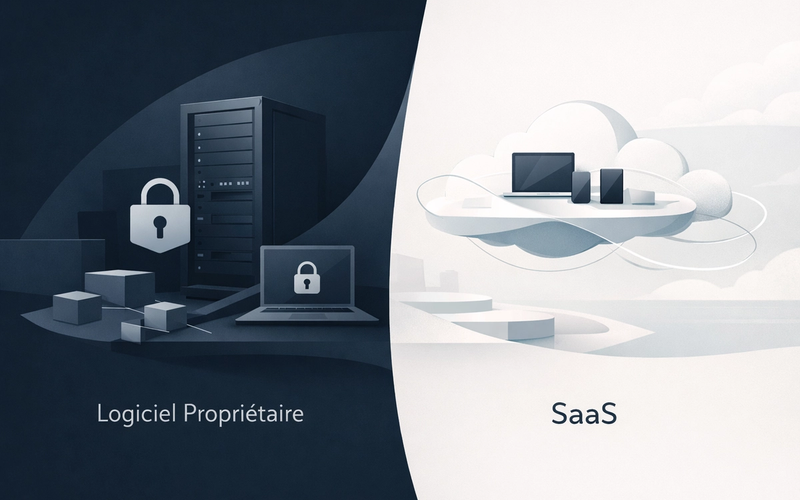
The most dangerous position is simple: “custom will necessarily be better”. That is false. A standard SaaS product is often superior when the process is common, not differentiating, already well covered by the market and not especially sensitive in terms of data or business rules. Buying gives you a mature product, regular improvements, existing support and a more predictable initial cost.
Building becomes credible when the process is structuring, your business rules are part of your advantage, data control matters, workflows are too specific or workarounds already cost more than scoping an internal product. Between both options, hybrid models are common: keep standard building blocks for accounting, CRM or authentication, and build the business layer that orchestrates rules, screens, permissions and integrations.
| Situation | Often rational option | Why |
|---|---|---|
| Standard process well covered by the market | Buy SaaS | Custom software would mostly create unnecessary maintenance. |
| Specific but non-strategic process | Configure or integrate | The cost of a full product is rarely justified. |
| Specific, critical and durable process | Build a business layer | The tool directly supports performance and control. |
| Spreadsheet prototype already used by several teams | Scope an internal MVP | The prototype reveals the need, but it is not enough for safe operations. |
| Clear product vision but unclear architecture | Product and technical scoping | Coding too early can freeze poor data, permission and maintenance choices. |
The most underestimated criterion is total cost over three to five years. An internal tool does not only have a development cost: it will need fixes, improvements, hosting, support, backups, monitoring, documentation and governance decisions. An honest comparison must include all of this, otherwise building looks artificially attractive.
What an internal tool MVP should cover — and what it should refuse
An internal MVP is not a poor version of the final product. It is the smallest version that lets a pilot group execute a real workflow end to end, with enough reliability to learn without putting the business at risk.
- A precise business scope: one process, one pilot team, a limited number of use cases.
- Clearly identified reference data: who creates it, who changes it, who approves it, who uses it.
- Simple but serious access rights: roles, permissions and minimum traceability.
- Backups, a reasonable recovery plan and visible error management.
- Integrations limited to the systems that are truly necessary for the MVP.
- Usage and quality indicators: adoption, processing time, errors, exceptions and user feedback.
What the MVP must refuse is just as important: rare edge cases, comfort requests, overly sophisticated administration screens, unvalidated automations, hypothetical user roles and integrations that do not yet serve the pilot workflow. Bluntly: if the MVP tries to satisfy everyone, it will test nothing properly.
Integrations and data: the heart of the product, not a secondary technical topic
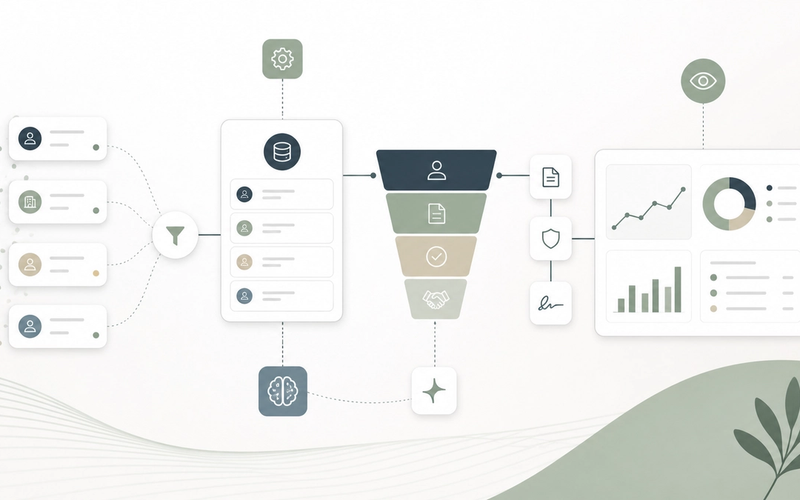
In many internal tool projects, the mistake is to start with screens. Screens are visible, so they feel reassuring. But the real product sits in the data: statuses, business objects, validation rules, history, documents, identifiers, reference data, permissions and synchronizations.
The best interface cannot compensate for poorly defined data. If two tools do not speak the same language, if a status means three different things depending on the team, if critical information lives in a free-text comment, the application will not solve the problem. It will make the problem look better.
Integrations should therefore be treated as product decisions. Which system remains the source of truth for which data? Which information must be synchronized in real time? Which error should block the process? Which error can be queued? Who receives the alert? What happens if a SaaS provider changes its API or limits? These are operating questions, not just development questions.
Example: an industrial services SME with a scattered business tool
Take a deliberately simple scenario. An industrial services SME manages customer requests, field operations, spare parts, quality approvals and final reports. The CRM holds the commercial history, a spreadsheet tracks interventions, a document tool stores reports, and approvals happen by email.
At first, the company asks for “an application to centralize everything”. That is not yet a good brief. After scoping, the real MVP might be much more precise: create an intervention file, retrieve customer data from the CRM, track three operational statuses, generate a standardized report, manage two user roles and push the final report to the document space.
This scope does not replace every tool. It creates a business layer that reduces duplicate entry, clarifies responsibilities and makes the process measurable. That is often the right level of ambition: structuring enough to create value, limited enough to avoid the fake big project.
Risks: homemade technical debt, supplier dependency and false control
Building an internal tool gives you control, but it also gives you responsibilities. The risk is not only paying too much. The risk is creating a critical system that nobody can evolve, with opaque architecture, weak documentation, insufficient tests and business rules buried in code.
Two ways to build an internal tool
Fragile project
- Features decided as the project goes
- Implicit data model
- Security added late
- Few tests and little documentation
- Strong dependency on one person or supplier
Maintainable product
- Prioritized workflow and explicit rules
- Data, roles and integrations scoped from the start
- Security, backups and traceability included in the MVP
- Understandable and tested architecture
- Knowledge transfer planned as part of delivery
References such as the NIST Secure Software Development Framework or the OWASP Application Security Verification Standard restate an obvious point that is too often forgotten: even an internal tool must be designed with serious security, verification and maintenance expectations. Software that is “only used internally” may still handle sensitive data, trigger operational decisions and expose the company to real risk.
Excessive supplier dependency is reduced through concrete choices: accessible source code repository, architecture documentation, simple development conventions, automated tests on critical flows, a technical decision log, clear secret management, and separation between business logic, integrations and interface. This is not luxury. It is the price of maintainability.
When not to invest in an internal tool
There are cases where development would be a poor decision. If the process changes every two weeks, software may freeze an unstable organization too early. If the need is 80% covered by a reliable SaaS product and the remaining 20% is not strategic, configuration or integration will probably be more rational. If nobody can own the product on the business side, the project will lack decisions. If the company does not accept the cost of maintenance, it should not build.
Custom software is powerful when it serves a clear business system. It becomes dangerous when it is used to avoid trade-offs, hide a poorly understood process or compensate for missing governance.
How to start without launching a large program
The first useful step is not a development quote. It is a short map of the real system: who does what, with which data, in which tool, according to which rule, with which exception and what risk if it fails.
A pragmatic scoping sequence
Describe the real workflow
Observe how the process actually works, including workarounds, exports and informal approvals.
Identify master data
Clarify business objects, statuses, data owners and source systems.
Decide between build, buy and hybrid
Compare SaaS, integration, automation and development based on differentiation, risk and total cost.
Define an operable MVP
Limit the scope, but include rights, backups, logs and essential integrations from the start.
Prepare maintenance
Document decisions and plan tests, support, monitoring and knowledge transfer.
This sequence avoids two opposite mistakes: buying too quickly a tool that will never fit the business, or building too quickly an application that reproduces existing ambiguities.
FAQ — Internal production and business tools
01 Who owns the code of custom internal business software?
02 Can we start from an Excel prototype?
03 How do we avoid excessive dependency on a supplier?
04 Should AI be integrated into an internal tool?
05 What budget should we plan for an internal tool?
Conclusion: build only when the tool becomes a business asset
Good internal software does not come from vague frustration with SaaS. It comes from a more precise observation: the company has a specific, important, durable process that is poorly served by existing tools and clear enough to be turned into a product.
In that case, the goal is not to “rebuild everything”. The goal is to build the minimum business layer that makes work more reliable, data more consistent, responsibilities clearer and future evolution easier to control. It is less spectacular than a major transformation program. It is also much more useful.
Key points
- Buy when the need is standard; build when the process is specific, critical and durable.
- Start with the workflow, data and business rules, not with screens.
- Limit the MVP, but never sacrifice permissions, security, backups and maintainability.
- Plan operations, integrations, documentation and knowledge transfer from the start.
- A successful internal tool is a maintainable business asset, not a more modern workaround.
Takora can assess one workflow, its data, required integrations and maintenance risks to decide whether to buy, integrate, automate or build custom internal business software.
Go further
Related resources
Sources
References and documentation