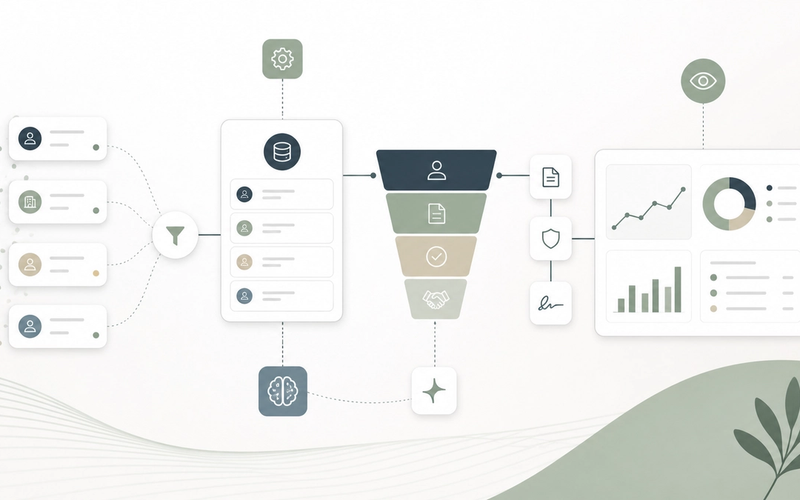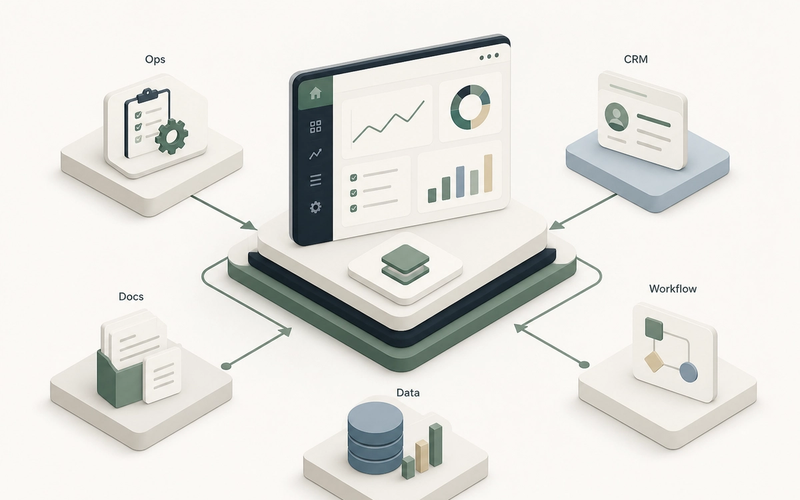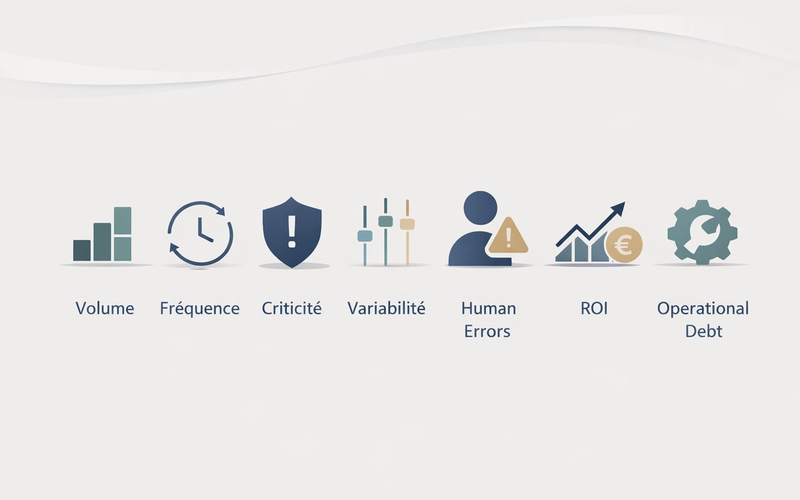
Business operations improvement is not about adding newer tools on top of poorly understood workflows. It is about making work visible, reliable and measurable: who does what, with which data, in which tool, at what point, and with what level of control. Takora works on operations and production when growth or complexity makes generic tools fail: fragmented data, critical processes still handled manually, limited real-time visibility, and too little operational margin to scale without breaking quality.
The essentials
- The goal is not to automate everything: first identify the workflows that create the most risk, delay or human dependency.
- Strong operations projects often start with a clear source of truth, explicit ownership and a few reliable integrations between existing tools.
- AI can help with specific use cases such as extraction, routing or quality control, but it cannot compensate for inconsistent data or an unclear process.
Business operations improvement starts with the breaking point
In many SMEs and mid-market companies, operations run for a long time thanks to highly capable people who know the exceptions by heart. That can work at first. It becomes fragile when volumes grow, responsibilities spread across teams or tools no longer reflect what actually happens on the ground.
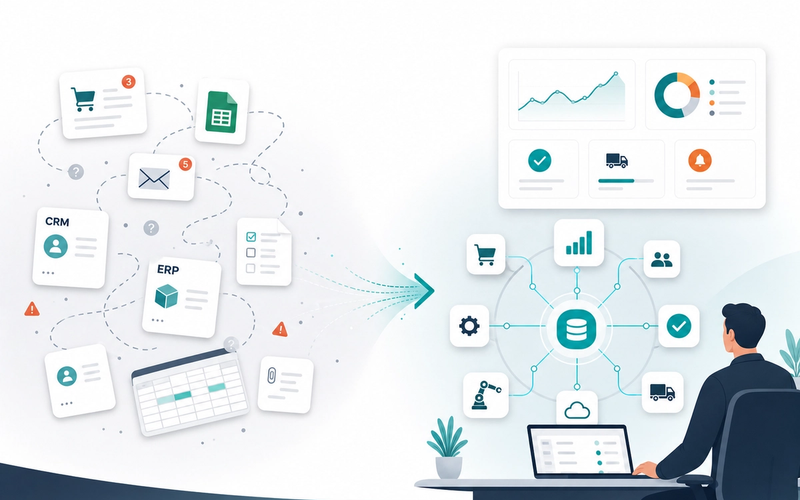
The warning sign is not always a visible delay. More often, it is coordination fatigue: a report rebuilt manually every Friday, an Excel file acting as the unofficial truth, an order moving across three tools with no shared identifier, or an operations lead forced to arbitrate exceptions that the system should already qualify.
In that context, buying a new tool may relieve a symptom without fixing the system. The first step is more direct: map the real workflow, identify where information degrades, then decide whether the problem calls for automation, integration, master data, an internal business tool or simply a better-defined operating rule.
The four signs that your operations are reaching saturation
Operational symptoms rarely appear in isolation. Scattered data creates manual checks. Manual checks slow reporting. Late reporting hides bottlenecks. And when the company hires or volume increases, the same weaknesses become far more expensive.
| Observed signal | What it often reveals | Priority response |
|---|---|---|
| Data scattered across several tools | Each team owns part of the truth, but nobody sees the full cycle. | Define master data, synchronization rules and shared identifiers. |
| Manual processes that are time-consuming and risky | Teams compensate for system limits through duplicate entry, copy-paste work or informal checks. | Automate stable steps, keep people on exceptions and document controls. |
| Lack of visibility over operations | Decisions rely on late, incomplete or manually rebuilt indicators. | Create reliable monitoring: statuses, events, cycle times, volumes, alerts and owners. |
| Operational scaling difficulties | Every increase in activity requires almost the same increase in human coordination. | Standardize critical workflows, integrate tools and isolate edge cases. |
This reading prevents a common mistake: confusing task volume with operational complexity. A repetitive task may be easy to automate. A workflow that crosses several teams, tools and business rules first needs a cleaner architecture.
Automate, integrate or rebuild: how to choose without launching an oversized project
Three responses often come up: automate a task, connect tools or build a business-specific tool. None is better by default. The right choice depends on process stability, data quality, error risk and the frequency of exceptions.
| Option | When it fits | When it is risky |
|---|---|---|
| Automation | The workflow is stable, repetitive, well understood and governed by explicit rules. | The process changes every week or depends on human judgment that has not been formalized. |
| Integration | The right tools already exist, but data moves poorly between them. | Each tool uses incompatible statuses, identifiers or rules without a business decision. |
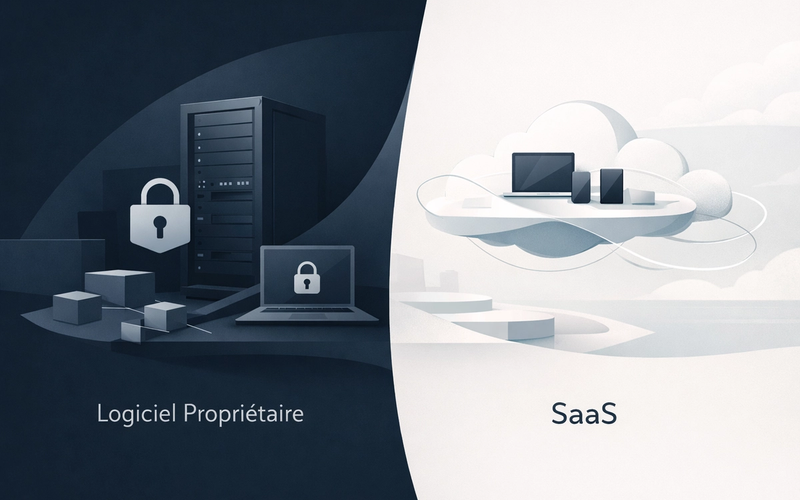
| Custom software | The process is differentiating, poorly covered by SaaS and critical to quality or margin. | The team tries to rebuild a full ERP without isolating the useful scope. |
| Light organizational redesign | The issue mainly comes from unclear ownership or undecided rules. | The team tries to fix a human alignment problem with code alone. |
The classic trap is the big bang: replacing the whole system instead of treating one priority workflow. In an already stretched organization, a poorly scoped large project adds workload before it creates value. A healthier approach is to select one process, measure its friction, fix the data and connect only what truly needs to be connected.
Data and reliability before more AI
AI can be very useful in operations, but only when it is placed in the right part of the workflow. It can help extract information from a document, pre-qualify a request, route a ticket, detect an anomaly or assist a quality check. It becomes risky when it is asked to hide missing rules, correct inconsistent data or make business decisions without traceability.
Before adding AI, answer simple questions: which data source is authoritative? Which event triggers the next step? Who validates exceptions? How do we verify that an automated decision is correct? What happens when the model is uncertain? These questions are less exciting than an AI demo, but they determine whether the system will hold up in production.
A strong operations architecture therefore accepts two realities. Some tasks should disappear because they are repetitive and error-prone. Some controls should remain human, but better equipped: with the right data, the right statuses and the right alerts.
Realistic example: an industrial SME that can no longer see delays early enough
Consider an industrial SME selling through distributors. Orders arrive in a CRM, product availability is tracked in an ERP, logistics adjustments happen by email and weekly reporting is consolidated in a shared spreadsheet. As long as volume is moderate, the team compensates. When orders increase, delays are detected too late, stock availability is interpreted differently across teams and customers receive inconsistent answers.
The first reflex might be to look for a new ERP. That may be useful one day, but it is not necessarily the right first move. A more pragmatic diagnosis may show that the real breaking point sits between the validated order, available stock and promised delivery date. The initial response can then be lighter: align statuses, create a shared order identifier, automate availability updates, trigger alerts when gaps appear and produce a daily operations dashboard.
This mini-case is not spectacular, and that is the point. Serious operations improvement rarely looks like a visible revolution. It usually looks like less duplicate entry, fewer grey areas, less dependency on one key person and more decisions made from reliable data.
Takora’s reading method: diagnosis, quick wins, scalable architecture
Useful operations work must avoid two extremes: staying at the level of theoretical consulting or jumping too quickly into development. The role of a serious technical partner is to translate an operational problem into concrete decisions: data, workflows, ownership, tools, risks and sequencing.
A reasonable sequence for improving a critical workflow
1. Map the real workflow
Observe the steps as they actually happen, including workarounds, parallel spreadsheets and informal validations.
2. Identify the authoritative data
Decide which source owns statuses, identifiers, amounts, deadlines and critical events.
3. Remove low-value manual work
Automate stable duplicate entry and notifications without removing human control where it is still needed.
4. Connect the useful tools
Create reliable integrations between existing systems instead of replacing the full stack by reflex.
5. Measure and harden
Track cycle times, errors, volumes and exceptions to make the system reliable before expanding scope.
This sequence creates value without freezing the business. It also creates a sound foundation if the company later decides to build a more strategic business tool or replace part of its stack.
Common mistakes in operations and production projects
- Automating an unstable process before clarifying business rules.
- Creating a dashboard without fixing the data that feeds it.
- Adding more SaaS tools without deciding which source is authoritative.
- Turning every exception into a feature instead of standardizing the normal case.
- Confusing development speed with production reliability.
- Launching a full rebuild when one priority workflow would be enough to validate the approach.
It is also important to know when not to invest. If volume is low, if the process changes every month, if the team has not agreed on decision rules or if basic data is not maintained, an ambitious build will probably create more debt than value. In that case, the best investment is often a short business clarification phase followed by a limited prototype.
How to structure operations without rebuilding everything
The most reliable starting point is to select a high-leverage workflow: order management, onboarding, procurement, planning, quality control, invoicing, internal support or production reporting. The workflow must be important enough to justify the effort, but contained enough to be understood in a few workshops.
- Name a business owner for the workflow.
- List the tools, files and channels actually used.
- Identify master data and critical duplicates.
- Measure delays, errors, duplicate entry and exceptions.
- Classify possible actions: business rule, automation, integration, internal tool or no action.
- Deliver one observable gain before expanding scope.
This discipline prevents an operational problem from becoming an abstract IT project. It forces every technical decision to connect to an observable result: fewer errors, less wasted time, better visibility, better service quality or the ability to absorb more volume without hiring in the same proportion.
FAQ — operations, production and scaling
01 Do we need to replace Excel if it is still everywhere in our operations?
02 How long does it take to get a first operational gain?
03 When is custom software better than a SaaS tool?
04 Can AI solve an operational productivity problem?
05 Where should we start if everything feels urgent?
Conclusion: scaling operations means reducing grey areas
An organization does not become more scalable because it adds a tool or an AI layer. It becomes scalable when critical workflows are understood, data is reliable, responsibilities are explicit and decisions are traceable. That is less spectacular than a broad digital transformation announcement, but much more solid.
For a CEO, COO or IT leader, the right question is therefore not only: which tool should we choose? It is: which workflow should we make reliable first, and what level of technology is actually needed to get there?
Key takeaways
- Do not start with the solution: start with the workflow that breaks.
- Find the authoritative data before automating.
- Favor reliable integrations and quick wins before a heavy rebuild.
- Use AI only when the process, data and controls are clear enough for production.
Takora can review a critical workflow, identify data or ownership breaks, and recommend the right trade-off between automation, integration and custom development.
Go further
Related resources
Sources
References and documentation