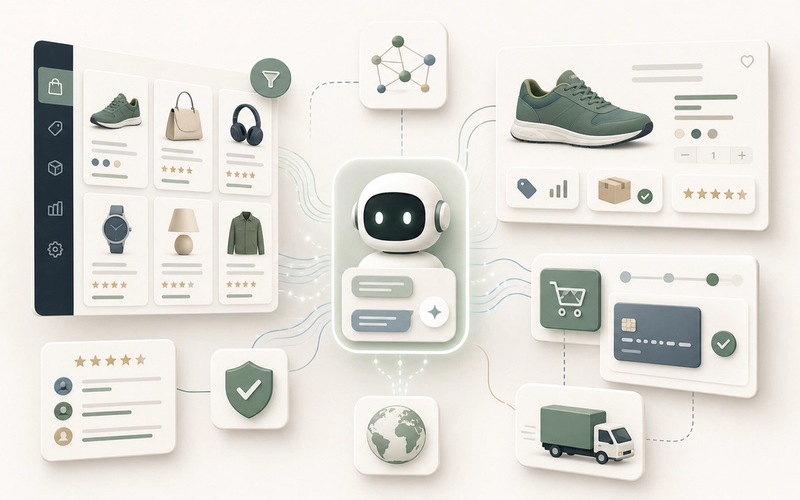
AI shopping agents for retailers are moving part of product discovery away from classic search results, site filters and paid campaigns. A customer can ask an assistant to compare options, remove products that do not fit their constraints, check a price and, in some cases, move further into the buying journey. For a retailer, the issue is not only generative engine optimization. It is whether the company can expose reliable product data, deliver on operational promises and be understood correctly by systems that summarize, filter and recommend.
The essentials
- Generative engine optimization, or GEO, aims to improve a brand’s presence in answers produced by generative engines. In ecommerce, it becomes useful only when catalog data, prices, inventory, reviews, delivery terms and return rules are clean and consistent.
- The right preparation is not to launch a broad AI program. It is to choose one priority product category, audit data and feeds, fix visible inconsistencies, then test how assistants describe and compare your products.
- Retailers should not invest everywhere. If margins are thin, inventory is unstable or the catalog lacks usable attributes, the first project is operational before it is marketing.
The real business problem: are your products understandable without your website?
In a traditional ecommerce journey, the retailer controls much of the context: navigation, product page, internal search, filters, recommendations, promotions and reassurance messages. With an AI assistant, that context may be reconstructed elsewhere. The assistant can extract information from multiple sources, summarize strengths and limits, compare competitors and display a compact answer.
The honest point is uncomfortable: if your value proposition is clear only inside a carefully designed product page, it is fragile. If sizes, variants, prices, lead times, reviews, materials, warranties or restrictions are scattered across the content management system (CMS), product information management system (PIM), enterprise resource planning system (ERP), marketplaces and spreadsheets, a generative engine may produce an incomplete or approximate representation.
Serious preparation therefore starts with an operational question: can an external system understand what you sell, who it suits, under which constraints, at what price, with what availability and service conditions? If the answer is no, GEO will not fix the problem. It will make it more visible.
AI shopping agents for retailers: what changes in practice
Shopping assistants do not simply display ten blue links. They can reformulate a need, surface decision criteria, compare products, highlight trade-offs, summarize reviews and direct users toward a merchant. OpenAI documents the Agentic Commerce Protocol, a standard designed to connect structured catalogs and some merchant journeys to ChatGPT. Google also describes shopping experiences in AI Mode with visual results, comparisons, product data and buying features that remain limited by country, partner access and eligibility rules.
What changes between classic search optimization and agentic commerce readiness
Classic search logic
- Optimize pages to attract a click to the website.
- Work on keywords, content, backlinks and web performance.
- Let the customer compare several pages and tabs manually.
- Measure mostly impressions, clicks, rankings and on-site conversion.
AI agent logic
- Make products readable inside synthetic and comparative answers.
- Structure attributes, variants, prices, inventory, reviews, delivery and returns.
- Help the agent understand which need the product fits, and which need it does not fit.
- Measure representation quality, data consistency and new entry points.
Search engine optimization, or SEO, is not going away. Pages, technical performance, useful content and reputation still matter. But they are no longer enough if the catalog cannot be used by systems that reason from product entities, structured attributes and trust signals.
The priority workstreams to prepare a catalog for generative engines
For an SME or mid-market retailer, the right move is not to rebuild everything. It is to address the points that actually change an AI agent’s ability to understand, compare and route a shopper. The following five workstreams cover the essentials.
| Workstream | What to make reliable | Why it matters |
|---|---|---|
| Product data | Titles, descriptions, attributes, variants, images, SKU (internal stock keeping unit), GTIN (global trade item number) when available | An agent cannot correctly recommend a product that is poorly described or ambiguous. |
| Price and availability | Current price, promotions, stock, update delays, out-of-stock logic | Gaps between what is shown and what is real damage trust and increase support cost. |
| Delivery and returns | Lead times, fees, zones, exceptions, returns, warranties | Assistants increasingly compare the full buying conditions, not only the price. |
| Trust signals | Reviews, ratings, expert content, FAQs, proof of use, quality policy | Generative engines rely on signals that help justify a recommendation. |
| Feeds and integrations | PIM, ERP, CMS, marketplace, Merchant Center, product feeds, application programming interfaces (APIs) | Data must stay current without manual re-entry or dependence on fragile files. |
The most profitable workstream is often less visible than expected: aligning systems. A polished product description is not worth much if the price comes from one tool, stock from another, delivery from undocumented rules and returns from a legal page that is never synchronized.
Realistic scenario: start with one product category before scaling
Imagine a home equipment retailer with 8,000 product references, a Shopify storefront, an ERP for inventory, supplier files for some attributes and a marketing team manually enriching best-selling product pages. The goal is not to make the entire catalog “agent-ready” in three months. That is unrealistic.
A better approach is to choose one high-margin, high-comparison category, such as ergonomic office chairs. For that category, the team checks the attributes that actually help a buyer decide: user height, maximum weight, adjustments, materials, warranty, delivery, returns, color-level availability, consistent images and differences between models.
Then it tests natural queries: “best office chair for remote work and back pain”, “ergonomic chair under $400 with fast delivery”, “compact chair for a small apartment”. The goal is not to manipulate the assistant. The goal is to see whether products are described correctly, whether advantages are justified, whether limits are visible and whether critical information is current.
What not to do: common mistakes in 2026
- Creating GEO content without fixing product data. This is the most common trap: adding explanatory pages while attributes, variants and inventory remain inconsistent.
- Confusing visibility with control. An AI assistant may summarize your offer, but you do not fully control its wording, comparison criteria or chosen sources.
- Overinvesting in an integration before the use case is clear. A product feed or API has value only if the category, margins, commercial rules and volumes justify the effort.
- Ignoring availability limits. Some AI shopping experiences are limited to certain countries, partners, categories or access statuses. Prepare the architecture without assuming universal availability.
- Forgetting customer support. If an agent sends customers with wrong expectations about lead time, sizing or returns, the operational cost lands in the support team.
The right posture is cautious: prepare what will remain useful, avoid overly specific bets and keep control of internal systems. Standards and platforms will evolve. Clean data, explicit rules and reliable integrations will remain useful.
How to decide where to start without creating unnecessary complexity
The first scope should be narrow enough to produce a verifiable result. One product category, one country, one private label, one B2B segment or one high-margin line is better than a broad audit that ends as unused documentation.
- Choose a category where customers compare heavily before buying.
- List the real decision criteria: price, use case, compatibility, size, delivery, warranty, social proof.
- Check whether these criteria exist as structured data in the PIM, CMS, ERP or current feeds.
- Identify gaps between the website, merchant feeds, marketplaces, customer support and internal data.
- Fix first the fields that change the decision: availability, variants, delivery, returns and differentiating attributes.
- Set up a control loop: query tests, Search Console or Merchant Center monitoring, feed error reviews and support feedback.
- Then decide whether to enrich content, automate feeds, build an API or connect a new agentic channel.
When should you not invest? If the catalog changes too quickly to be maintained, if inventory is often wrong, if margin per order is too low, or if no team owns product data clearly, the budget should first go to operational reliability. AI will not sustainably compensate for an unstable base.
Takora’s role: clarify before building
A serious project at this level rarely touches one tool only. It may involve a CMS, PIM, ERP, marketplace feeds, Google Merchant Center, enrichment scripts, pricing rules, support tooling and architecture choices. The risk is not only technical: it is organizational.
Takora helps when a company needs to turn a vague topic into a useful system: map data flows, decide what should be automated, define a calm architecture, build connectors, make data reliable and deliver a first measurable scope. The goal is not to chase a trend. The goal is to make operations clear enough for new channels to rely on them.
FAQ: AI shopping agents and ecommerce readiness
01 Does GEO replace ecommerce SEO?
02 Do retailers need a specific product feed for ChatGPT or AI agents?
03 Which product data matters most?
04 Should a mid-market retailer invest in 2026?
05 What is the best first project?
Conclusion: preparing ecommerce for AI starts with making the company readable
AI shopping agents do not require retailers to throw away their ecommerce stack. They force a stricter discipline: clear catalog, structured attributes, reliable prices and inventory, explicit service rules, useful content and maintainable integrations. That is less spectacular than an AI announcement, but much more defensible.
Key takeaways
- Start with one product category, not the whole company.
- Fix data inconsistencies before optimizing content.
- Keep SEO, and add a readability layer for generative engines.
- Build an agentic integration only when a use case, margin and operational capacity justify it.
- The best advantage in 2026 is not to be loud about AI, but to be technically and operationally reliable.
Takora can audit one priority product category: attribute quality, price-inventory feeds, delivery rules, returns, structured data and gaps between the website, ERP, PIM, marketing tools and customer support.
Go further
Related resources
Sources
References and documentation